
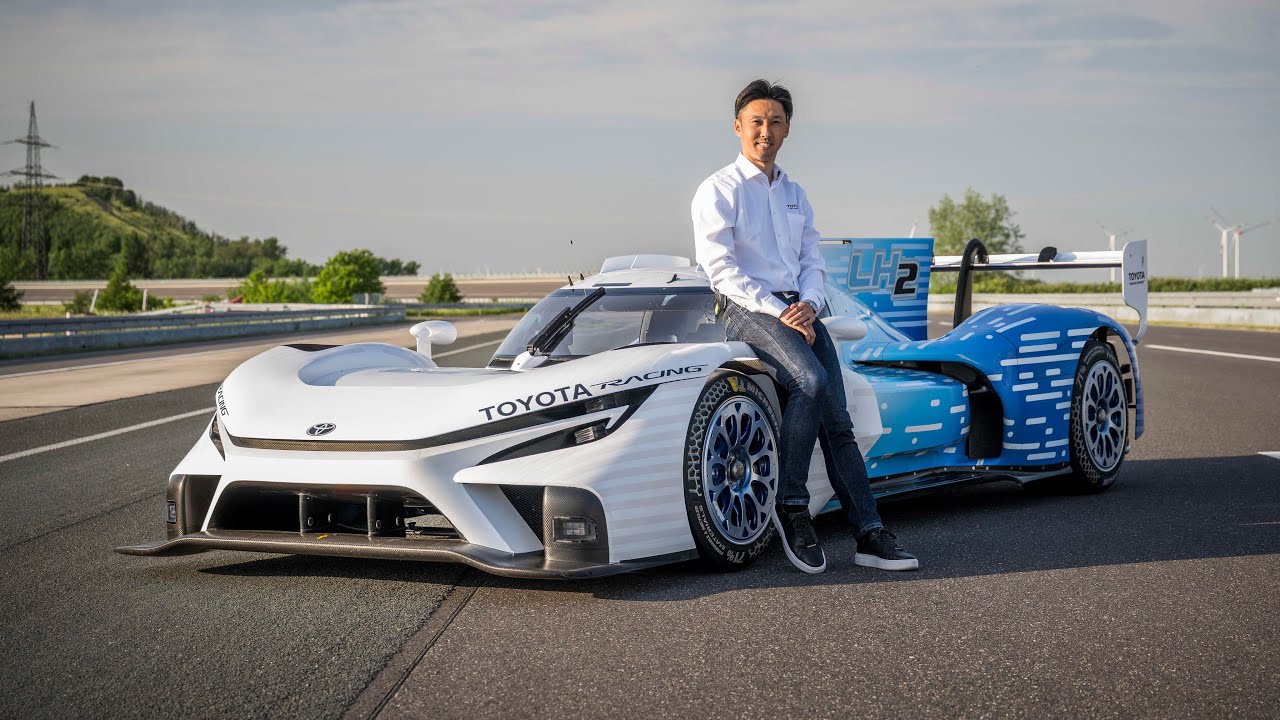
Le Mans has always been Toyota's stage for the future as much as the present, and in 2026 the Japanese marque will use the world's most famous endurance race to push its boldest environmental bet yet onto the Circuit de la Sarthe.
The TR LH2 Racing Prototype — a competition car powered not by a hybrid system or a battery, but by a combustion engine burning liquid hydrogen — is set to run demonstration laps in front of the Le Mans crowds during race week. Toyota has scheduled the runs for Thursday 11 June and again on Saturday 13 June, hours before the 24 Hours itself gets under way.
Built on the same chassis architecture as the TR010 HYBRID Hypercar that Toyota campaigns for outright victory, the LH2 prototype represents the next step in a hydrogen programme the company has pursued in public view for several years.

Crucially, the car does not use a hydrogen fuel cell. Instead it retains an internal combustion engine — preserving the noise, throttle response and rapid refuelling of conventional racing machinery — but feeds it liquid rather than gaseous hydrogen. Stored at extreme cold, liquid hydrogen is far denser than its gaseous form, allowing more energy to be carried on board and easing one of the technology's biggest packaging headaches.
The journey to this point has been deliberately staged at the Sarthe. Toyota first stunned the paddock with its GR H2 Racing Concept, a world premiere at Le Mans, before progressing from early gaseous-hydrogen experiments in the GR Corolla H2 to the liquid-hydrogen path showcased more recently by the GR LH2 Racing Concept. The TR LH2 is the most race-ready expression of that lineage so far.
The prototype will be a centrepiece of the Hydrogen Village, the dedicated fan and technology area that organisers open on 10 June to showcase the fuel's potential for both motorsport and road cars. Toyota's argument has remained consistent throughout: that the unforgiving environment of top-level racing hardens new technology faster than laboratory testing alone, exposing components to stresses no test bench can fully replicate.
The Automobile Club de l'Ouest, which runs Le Mans, has spent years positioning hydrogen as a pillar of endurance racing's long-term future, and a working demonstration in front of a quarter of a million spectators keeps that momentum alive. For Toyota, the symbolism is pointed: a car that makes no carbon dioxide at the tailpipe, lapping the same circuit where it has won the 24 Hours outright, offering a glimpse of how the great race might sound and smell decades from now.

---
*Originally published on [Motorsports Global](https://motorsports.global/article/toyota-tr-lh2-hydrogen-prototype-le-mans-2026). Visit for full coverage.*